Best airbrush for miniatures

An airbrush is the upgrade that makes priming and basecoating fast and smooth once you paint a lot — but it is not a beginner's first buy, and it comes with real safety needs. This guide compares beginner airbrushes on the specs that decide the fit: needle size, feed type, trigger and cup, plus whether a listing is a full kit or a standalone airbrush. Ventilation and a respirator come first, because they are not optional.
A note on how to read this. An airbrush is a system — the airbrush, an air source, paint thinned to spray, and a safe setup. So the value here is the framework for choosing the airbrush itself, then a short list of picks once they are verified. Read the framework first, then look at the picks.
How to choose a beginner airbrush
Four specs decide whether an airbrush suits a beginner painting miniatures. Run any airbrush through these — they are the columns in the comparison below.
Needle size — 0.3mm is the all-rounder
The needle size sets how fine a line the airbrush can spray. A 0.3mm needle is the common all-rounder for miniatures, balancing fine control for basecoats and fades with enough flow for priming. Finer needles suit very detailed work but clog more easily; wider needles prime fast but spray coarse. For a first airbrush, 0.3mm covers the most ground. The tools and airbrush hub explains the specs in more depth.
Feed type — gravity feed for minis
Gravity feed, with the cup on top, is the usual choice for miniatures: it sips less paint, sprays at lower pressure and cleans easily, all of which suit small jobs. Siphon feed draws from a bottle below and holds more for large surfaces, but is less economical for minis. Most beginner miniature airbrushes are gravity feed for good reason.
Trigger — dual-action for control
A single-action trigger controls air only, which is simpler but blunter. A dual-action trigger controls air and paint together — press for air, pull back for paint — giving far finer control over coverage and fades. Dual-action has a small learning curve but is what most miniature painters end up wanting, so it is worth starting there.
Cup size, and kit or standalone — the total cost
A small cup is fine for minis and quick to clean; a larger cup suits priming batches without refilling. Just as important: an airbrush needs an air source, and many beginner options sell as a kit with a small compressor. Check whether a listing is a kit or a standalone airbrush, because it changes the total cost considerably.
The airbrushes compared
A short list of widely available beginner airbrushes, compared on the four specs above. Specs are verified against manufacturer data and current Amazon listings — no hands-on testing claims, just the details that decide the fit.
| Best for | Needle size | Feed type | Trigger | Kit / standalone |
|---|---|---|---|---|
| Best overall beginner | 0.35mm (N3 head system) | Gravity | Dual-action | Standalone airbrush (no compressor or hose) |
| Best budget | 0.2mm / 0.3mm / 0.5mm (three complete interchangeable sets) | Gravity | Dual-action (internal mix) | Includes 3 tip/needle/nozzle sets, quick-disconnect, nozzle wrench, storage case — no hose or compressor |
| Best airbrush + compressor kit | 0.2mm / 0.3mm / 0.5mm (3 interchangeable tip sets on G222 airbrush) | Gravity | Dual-action | FULL KIT — G222 airbrush + TC-326T compressor (1/5 HP, dual fan, 3L tank) + 6ft braided hose + holder + regulator + water trap + quick-disconnect |
| Best for fine work | 0.2mm | Side-feed (configurable left or right-hand; expandable to 1/4–1 oz cups) | Dual-action with pre-set handle | Standalone airbrush only |
| Best step-up | 0.28mm self-centering FineLine nozzle (compatible with 0.45mm and 0.6mm nozzle sets) | Gravity | Dual-action with Trigger Cam / Excenter control system | Standalone airbrush (includes needle stop and storage box) |
Our top picks
Best overall beginner: NEO for Iwata CN Gravity Feed Dual-Action Airbrush

Best overall beginner
NEO for Iwata CN Gravity Feed Dual-Action Airbrush
Iwata (Anest Iwata-Medea)
- Needle size: 0.35mm (N3 head system)
- Feed type: Gravity
- Trigger: Dual-action
- Cup size: 7ml + 3ml interchangeable cups included
- Kit / standalone: Standalone airbrush (no compressor or hose)
- Best for: First airbrush — basecoating, layering, and smooth blends on miniatures
The #1 recommended beginner airbrush for miniature painting. The Iwata Neo CN delivers fine atomisation at low pressure (8–20 psi), works well with entry-level compressors, and ships with two interchangeable cup sizes. Backed by a 5-year Iwata warranty.
Last checked 2026-05-21
Best budget: PointZero Dual-Action Gravity-Feed Airbrush — 3 Tip Set (0.2mm, 0.3mm, 0.5mm)

Best budget
PointZero Dual-Action Gravity-Feed Airbrush — 3 Tip Set (0.2mm, 0.3mm, 0.5mm)
PointZero
- Needle size: 0.2mm / 0.3mm / 0.5mm (three complete interchangeable sets)
- Feed type: Gravity
- Trigger: Dual-action (internal mix)
- Cup size: 2cc gravity cup
- Kit / standalone: Includes 3 tip/needle/nozzle sets, quick-disconnect, nozzle wrench, storage case — no hose or compressor
- Best for: Budget entry — three tip sizes let beginners experiment from fine detail to broad coverage
Exceptional value under $30, the PointZero 3-tip set includes three complete needle and nozzle configurations so beginners can experiment with fine hairline detail (0.2mm), general purpose coverage (0.3mm), and broad base-coat spray (0.5mm) — all in one box.
Last checked 2026-05-21
Best airbrush + compressor kit: Master Airbrush Cool Runner II Dual Fan Compressor System Kit with G222 Gravity Airbrush (0.2, 0.3, 0.5mm Tips)

Best airbrush + compressor kit
Master Airbrush Cool Runner II Dual Fan Compressor System Kit with G222 Gravity Airbrush (0.2, 0.3, 0.5mm Tips)
Master Airbrush (TCP Global)
- Needle size: 0.2mm / 0.3mm / 0.5mm (3 interchangeable tip sets on G222 airbrush)
- Feed type: Gravity
- Trigger: Dual-action
- Cup size: ~10ml (1/3 oz) gravity cup
- Kit / standalone: FULL KIT — G222 airbrush + TC-326T compressor (1/5 HP, dual fan, 3L tank) + 6ft braided hose + holder + regulator + water trap + quick-disconnect
- Best for: Complete beginners — plug in and paint with no additional purchases
The most popular complete airbrush + compressor combo for miniature painters. The G222 handles fine detail through broad base-coating with its three interchangeable tips, while the TC-326T's 3-litre tank delivers smooth, pulse-free air pressure for consistent results straight out of the box.
Last checked 2026-05-21
Best for fine work: Iwata High Performance HP-SB Plus Side Feed Dual-Action Airbrush (0.2mm)
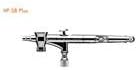
Best for fine work
Iwata High Performance HP-SB Plus Side Feed Dual-Action Airbrush (0.2mm)
Iwata (Anest Iwata-Medea)
- Needle size: 0.2mm
- Feed type: Side-feed (configurable left or right-hand; expandable to 1/4–1 oz cups)
- Trigger: Dual-action with pre-set handle
- Cup size: 1/8 oz (3.8ml) standard side cup
- Kit / standalone: Standalone airbrush only
- Best for: Ultra-fine detail — OSL, eyes, freehand, and single-model showcase work
Iwata's HP-SB Plus is the benchmark 0.2mm precision airbrush for miniature detail work, producing hairline-to-3/4" spray patterns with total control. The pre-set handle reduces finger fatigue during extended sessions and the side-feed design gives an unobstructed view of the painting surface.
Last checked 2026-05-21
Best step-up: Harder & Steenbeck Evolution 2024 CRplus Solo — 0.28mm Self-Centering Nozzle

Best step-up
Harder & Steenbeck Evolution 2024 CRplus Solo — 0.28mm Self-Centering Nozzle
Harder & Steenbeck
- Needle size: 0.28mm self-centering FineLine nozzle (compatible with 0.45mm and 0.6mm nozzle sets)
- Feed type: Gravity
- Trigger: Dual-action with Trigger Cam / Excenter control system
- Cup size: 2ml integrated gravity cup with lid
- Kit / standalone: Standalone airbrush (includes needle stop and storage box)
- Best for: Experienced painters ready to step up — NMM, OSL gradients, smooth blends
Precision-machined in Germany to tighter tolerances than most airbrushes at this price, the Evolution 2024 CRplus features a self-centering nozzle that snaps into perfect alignment on assembly and disassembles entirely by hand — no tools required — for faster, more consistent cleaning.
Last checked 2026-05-21
Who should buy what
Painters new to airbrushing
A 0.3mm gravity-feed, dual-action airbrush as a kit with a compressor is the least frustrating start — one purchase, one learning curve. Learn to thin paint and clean the airbrush after every session before you worry about a finer needle.
Batch and army painters
Priming and basecoating is where an airbrush earns its keep across many models. A slightly larger cup saves refilling, and pairing it with one-coat high-pigment paints gets a force tabletop-ready fast.
Detail and display painters
A finer needle and dual-action control suit smooth coats and subtle fades on a showcase model. This is a step-up purchase once your control and cleaning routine are solid, not a first buy.
What to feed your airbrush
An airbrush is only as good as the paint you put through it — acrylic thinned to spray, cleaned out after every session. If you are choosing paint that airbrushes well alongside your hand colours, start with the right set: see the best miniature paint set guide for how colour range, paint type and pigment decide the fit, including one-coat high-pigment paints that prime and basecoat fast. The tools and airbrush hub covers the wider workspace and safety if you want it first.
Frequently asked questions
Do I need an airbrush to paint miniatures?
No. An airbrush is an upgrade, not a requirement, and you should learn to thin paint and hand-brush first. Where it earns its place is speed and smoothness at scale — priming and basecoating whole batches fast with an even finish. If you paint armies or print models faster than you can paint them, an airbrush changes the maths. Otherwise, a brush is plenty.
What needle size is best for miniatures?
A 0.3mm needle is the common all-rounder for miniatures, balancing fine enough control for basecoats and fades with enough flow for priming. Finer needles suit very detailed work but clog more easily; wider needles spray faster and coarser, better for priming batches than fine work. For a first airbrush, 0.3mm covers the most ground.
Gravity feed or siphon feed?
Gravity feed, where the paint cup sits on top, is the usual choice for miniatures — it sips less paint, sprays at lower pressure and cleans easily, which suits small jobs. Siphon feed draws from a bottle below and holds more paint for large surfaces, but is less economical for minis. Most beginner miniature airbrushes are gravity feed for these reasons.
What is the difference between single-action and dual-action triggers?
A single-action trigger controls air only, with the paint flow set separately, which is simpler but blunter. A dual-action trigger controls air and paint together — press for air, pull back for paint — giving far finer control over coverage and fades. Dual-action has a small learning curve but is what most miniature painters end up wanting.
Do I need a compressor too, or does it come in a kit?
An airbrush needs a compressed air source, and many beginner options sell as a kit with a small compressor, which is the simplest way to start. Buying the airbrush alone makes sense only if you already have a suitable compressor. Look at whether the listing is a kit or a standalone airbrush, since it changes the total cost considerably.
Is airbrushing safe indoors?
Only with proper precautions. An airbrush atomises paint into a fine mist you should never breathe, so use it in a well-ventilated space, ideally with a spray booth that vents outside, and wear a properly fitted respirator rated for paint particulates — not a dust mask. The same applies to spray priming. This is not optional; no finish is worth your lungs.
What paint do I put through an airbrush?
Acrylic thinned to a milk-like or thinner consistency so it atomises without clogging the needle. Some paints are sold airbrush-ready; standard acrylics usually need thinning with water or a dedicated airbrush thinner. One-coat high-pigment paints can airbrush well too. Thin paint and clean the airbrush after every session to keep it spraying reliably.